

In November 2025, Infrastructure Victoria released Victoria’s infrastructure strategy 2025–2055. One key recommendation was to invest in 12 cycling corridors in Melbourne and a network of cycle corridors in Geelong, Ballarat, Bendigo and Wangaratta over the next 10 years. Media release. Full report.
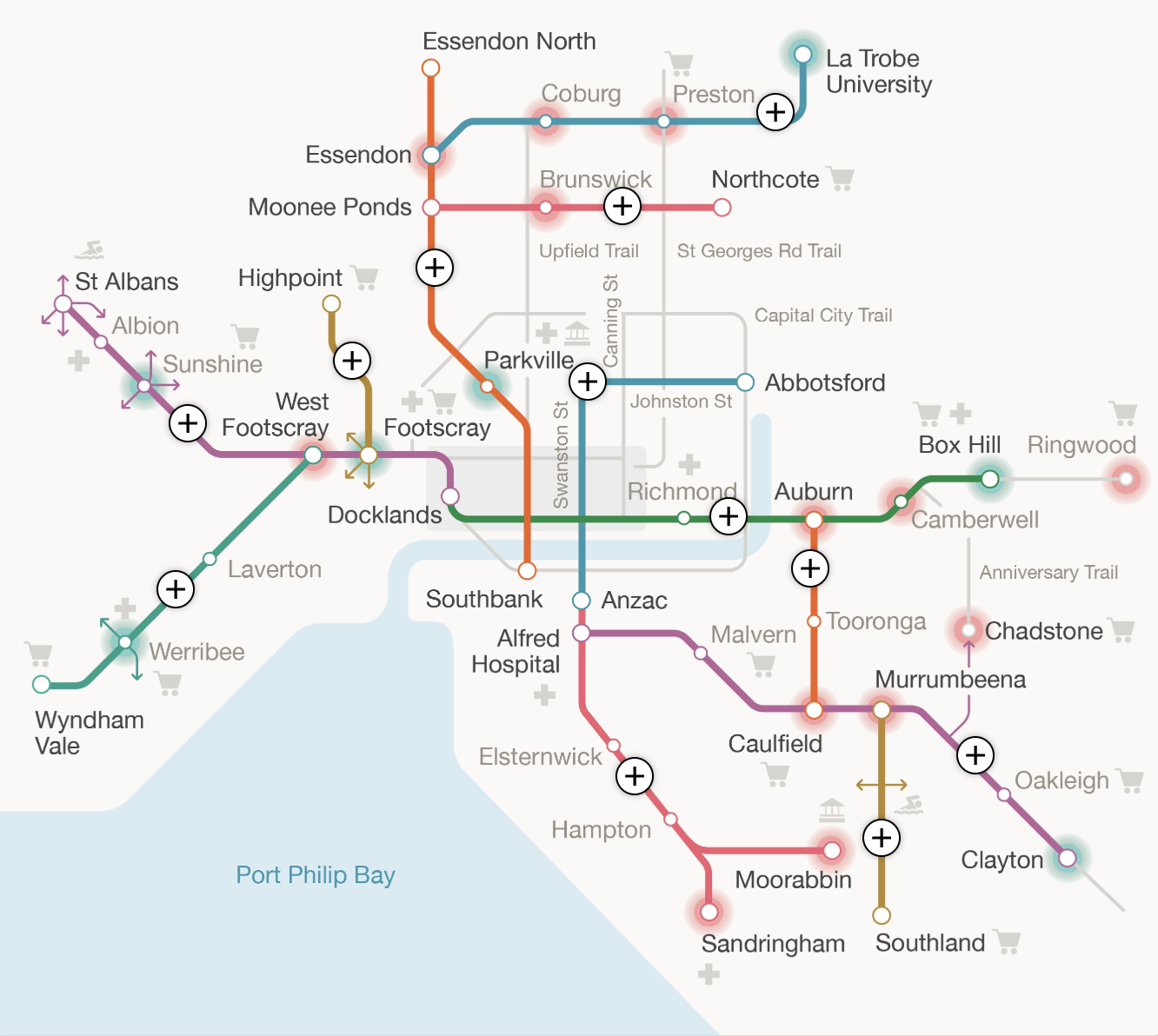
Melbourne cycling corridors advocated by Infrastructure Victoria
The Anzac station to Sandringham (with a spur link to Moorabbin) would be a massively useful transport link for for the south-east. The Infrastructure Victoria report includes:
The benefit-cost ratio for this route is 2.4 - 3.5
The route proposed follows the Strategic Cycling Corridor path, and includes the already-built Anzac Station to St Kilda Junction, then continues down St Kilda Rd to Glen Huntly RD, where it follows New St to the beach, then follows Beach Rd to Sandringham.
The Moorabbin link follows South Rd
The proposed infrastructure for this route is mostly on-road protected bike lane, with bikes protected by bollards or parked cars.
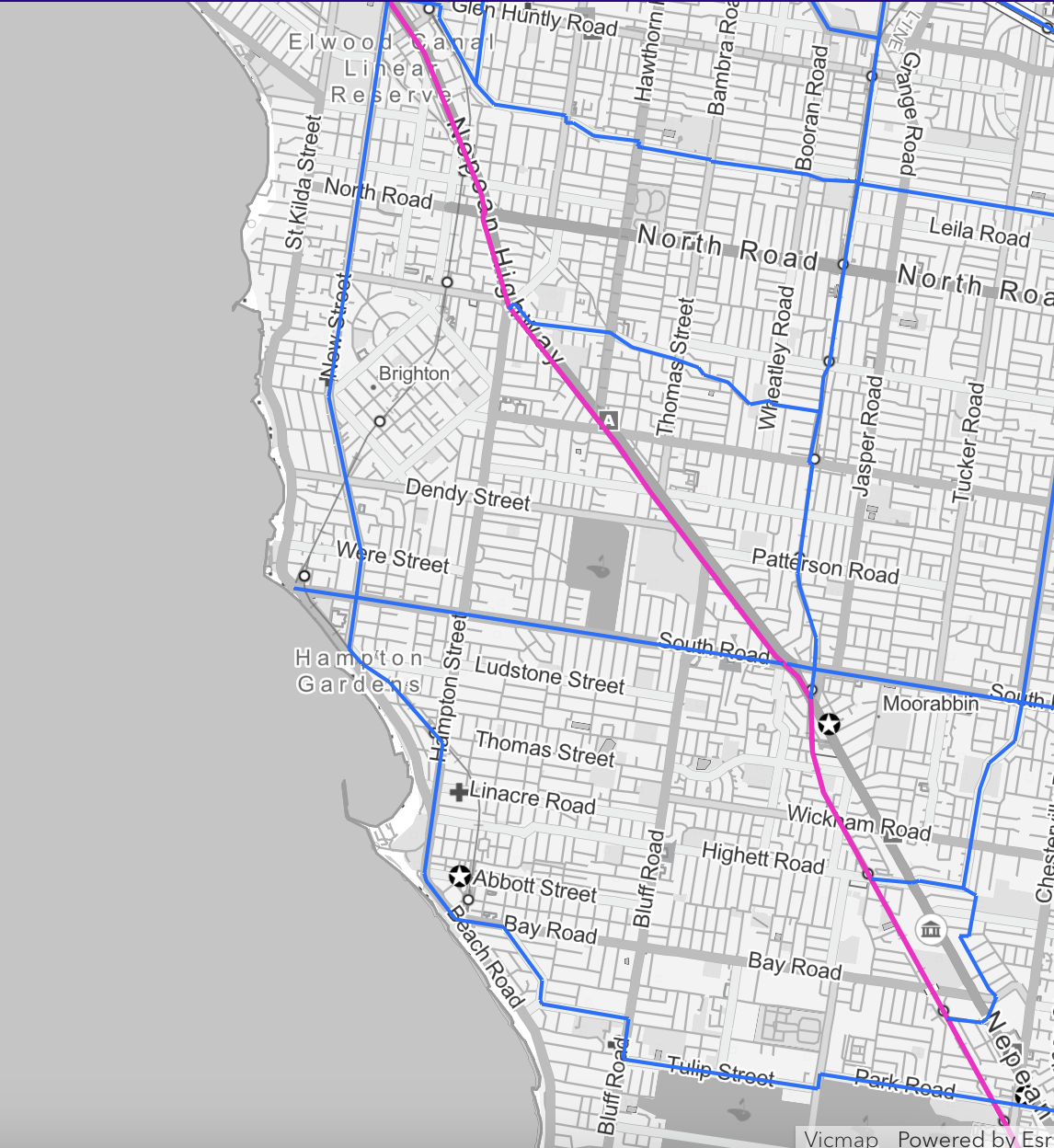
The strategic cycling routes in the area. The Anzac-Sandy route follows New St, with a branch along South Rd to Moorabbin. Via https://experience.arcgis.com/experience/53181c144cec477497e01d166c64a6eb
comments on the route
Here I am assuming that the route will follow the Strategic Cycling Corridor, though this is also somewhat unresolved. It may be that there are better options for some sections (leave a comment below to suggest these).
The section Anzac Station to St Kilda Junction is complete, though there is scope for improvement around intersections.
The section St Kilda Junction to Carlisle St was reportedly designed as part of the St Kilda Rd bike lanes, but not built for budget reasons. This section should be straightforward to implement, with a wide road. It is also critically needed, as heavy trucks take the lane adjacent to the painted bike lane to position themselves for the left turn onto Queens Rd.
The section Carlisle St to Glenhuntly Rd currently consists of a central road/tram corridor, and separated two-lane corridors in each direction, with a painted bike lane and a parking lane. This could have the same treatment as further north on St Kilda Rd, with a protected bike lane adjacent to the curb, and either a parking lane and single traffic lane, two traffic lanes, or where space permits, a parking lane and two traffic lanes.
The intersection Brighton Rd to New St, southwards looks challenging; at this point New St is one way (for vehicles) with a counterflow for bikes, so it isn’t possible to make this turn via car. There are also tram tracks. At the moment I’d make this turn with a hook turn, pausing either on the footpath or right in front of it, crossing Brighton Rd with the pedestrian lights, then connecting to New St via the footpath.
New St adjacent to Yalukit Willam and Elsternwick Parks has a quite wide corridor, with ample parking (either angle parking in some areas, a 90 deg parking area south of the roundabout on the road side of a service road, and other wise parallel parking).
New St south of these parks is generally on-street parallel parking on both sides, with a painted bike lane in the door zone. Intersections include large and small signalised intersections (eg North Rd, Martin St); large roundabouts (eg intersection at St Andrews/Well/Park Sts, and the complicated roundabout at Dendy St that crosses the rail line)
From the south end of New St, the indicated route does not join Beach Rd or the Bay Trail, but rather runs along the rail line. Between Holyrood and Orlando Streets, there is no existing path, but there is possibly room in the south side of the rail corridor.
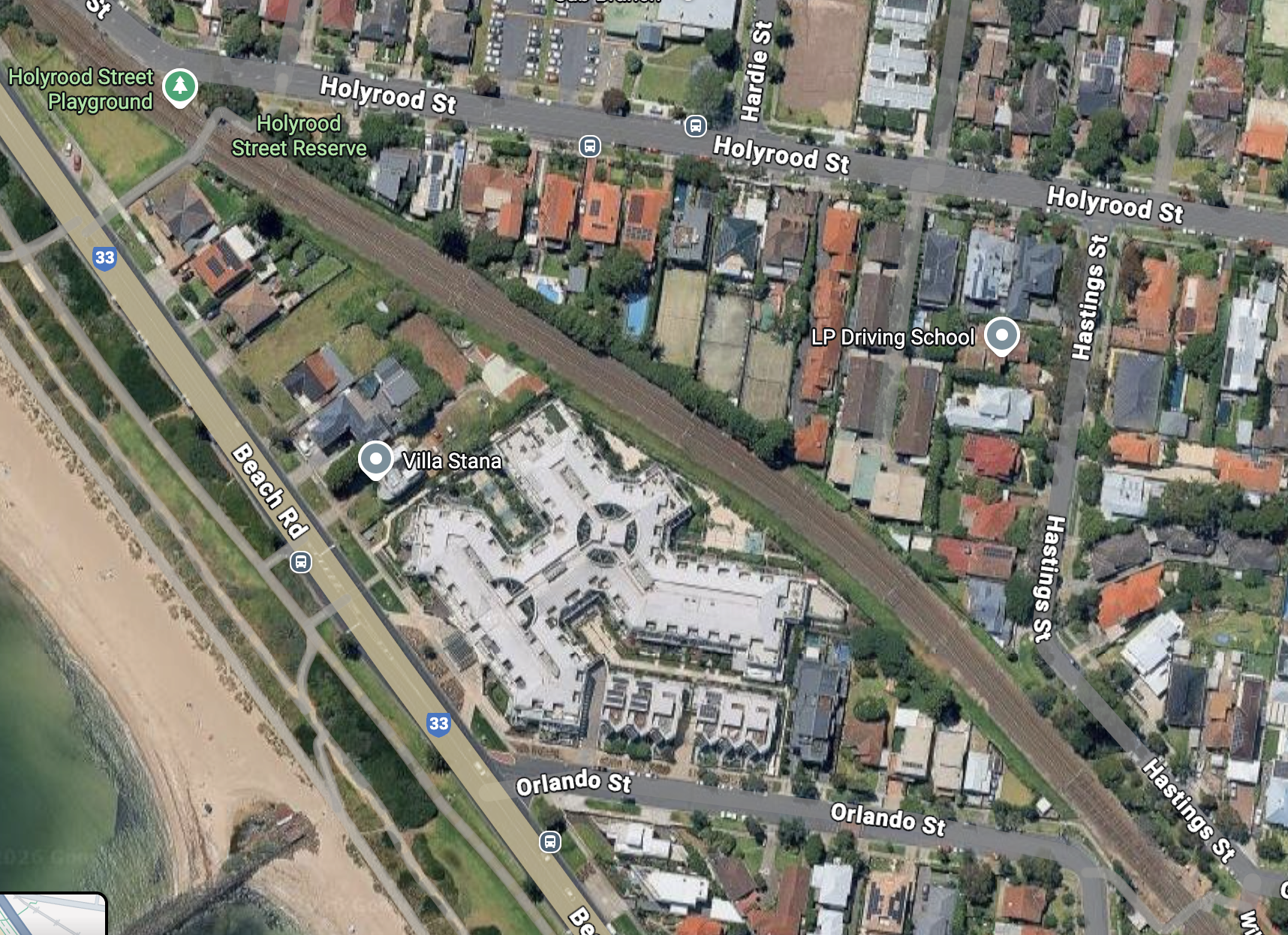
Rail corridor between Holyrood and Orlando St
South of Orlando there is no space for a path, but it may be possible to cross the rail line to the east side at the pedestrian level crossing and use Willis St, which is already a pleasant, low speed environment. This connects to Koolkuna Lane, which is currently one-way but could be modified to include contraflow movements for bikes. This brings us to Hampton station.
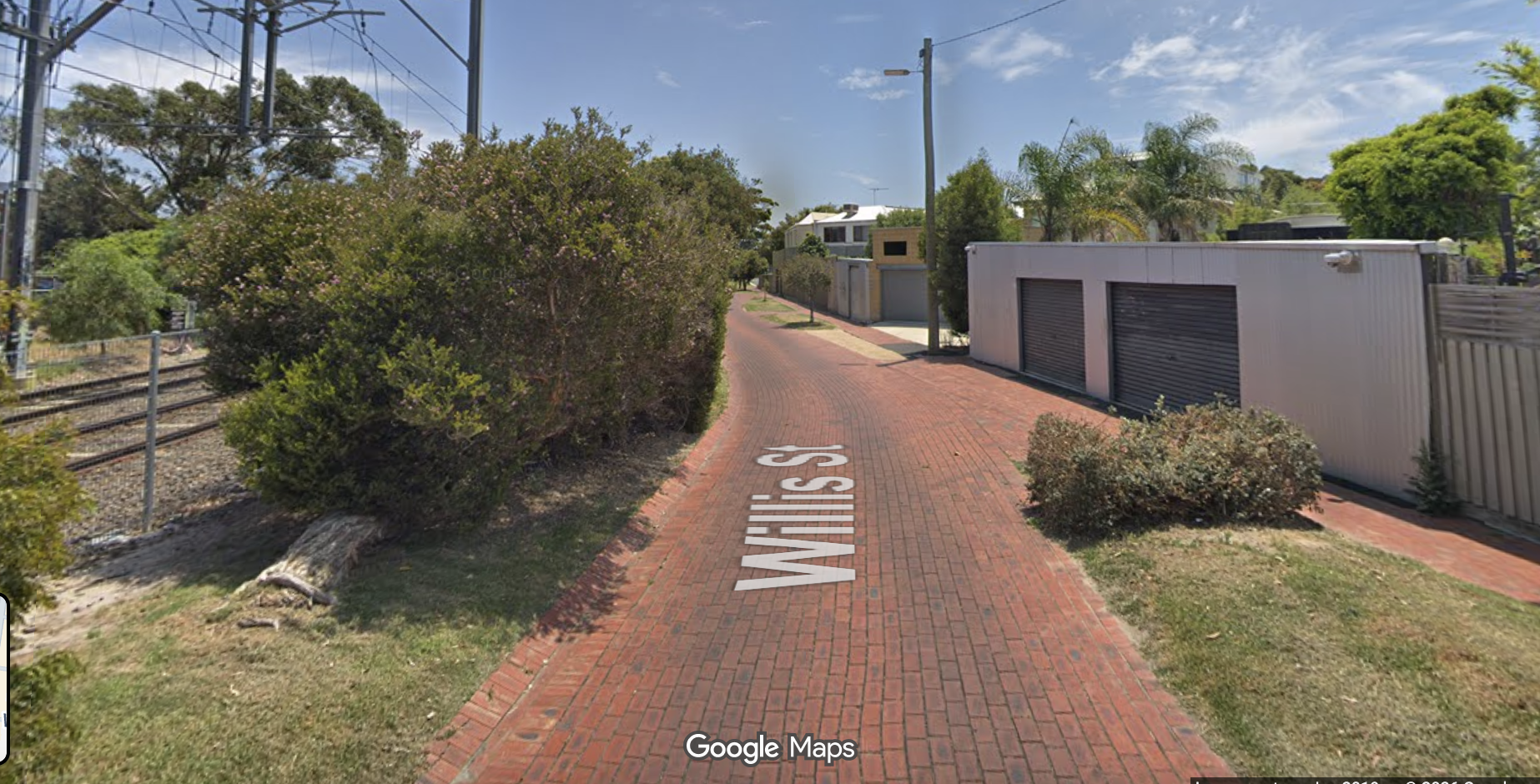
Willis St, east side of rail corridor
Hampton station to Beach Rd via Hampton St. Near Hampton Station this is a busy high street with on-street parking, making this safe for active travel while keeping the on-street parking would be challenging. Further south, it is a standard two-way carriageway with on-street parking, generally not highly utilised. This would be technically straightforward to include protected bike lanes but as ever politically challenging.
Hampton St merges with Beach Rd. The difficulty here is providing bike infrastructure that is suitable for a wide range of cyclists, while allowing the bunch rides to maintain their current use. A standard width protected lane would not be suitable for bunch rides.
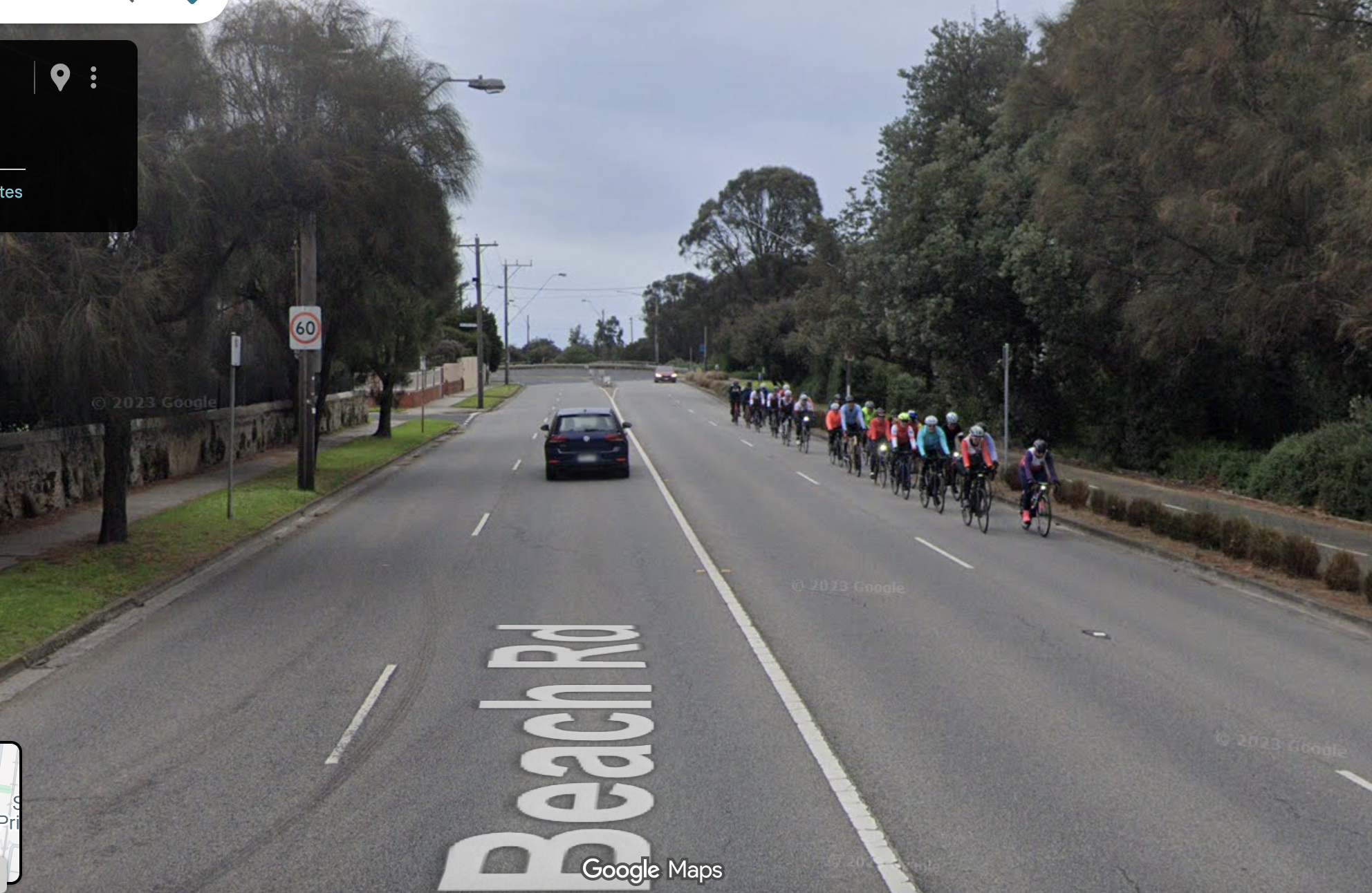
Beach Rd, with a large group (about 20) of bike rides using the outer lane.
The route ends at Sandringham station.
Port Phillip BUG plans to ride this route in the near future, keep an eye on our social media for dates. Comments welcomed.
Added 7/02/26: An alternate route servicing a similar catchment would be the C1 strategic route along Nepean Highway (in pink in the map above). David Blom from Metro East BUG has made a post about how this route could work (facebook ).